Posted in classroom management, English escapades, Lesson plan component, teaching

First day of school

I started a new teaching job. This year I’m teaching English, Spanish, and Theatre Arts at a small school. I’m mostly teaching 5th-8th grade, though I do have a specials rotation with 3rd abs 4th grade.

Every year I start my classes out basically the same way: students fill out info and goals sheets as bell work while I do first day attendance and housekeeping. Next, I do a basic introduction presentation and go over my syllabus. If there is time, we do the name game, and class promptly ends. Seven years. ~1000 kids.

This time, I did something different. Year 8 began with stations. I said hello, we made name tents, and off they went to 5 different stations. (1) student info and goal setting, #goals, (2) syllabus puzzle (using block posters) and syllabus quiz, (3) book tasting from my classroom library, (4) a reading survey, and (5) write a letter to yourself.

Doing something different has already changed everything about my class. I was able to teach my expectations by showing my students instead of telling them. They were able to experience my procedures for grouping and moving around the room. And, I got to see how and with whom they interact. It was a success.

-CL

Posted in Uncategorized

Writing

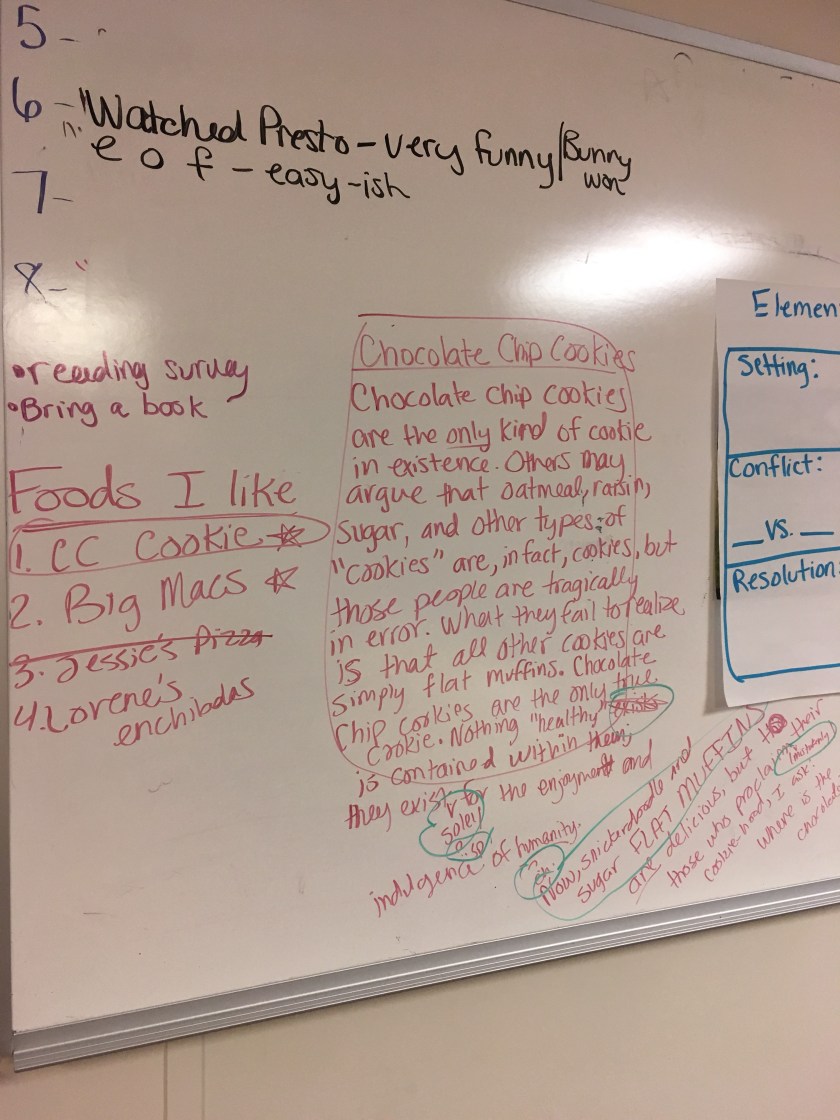
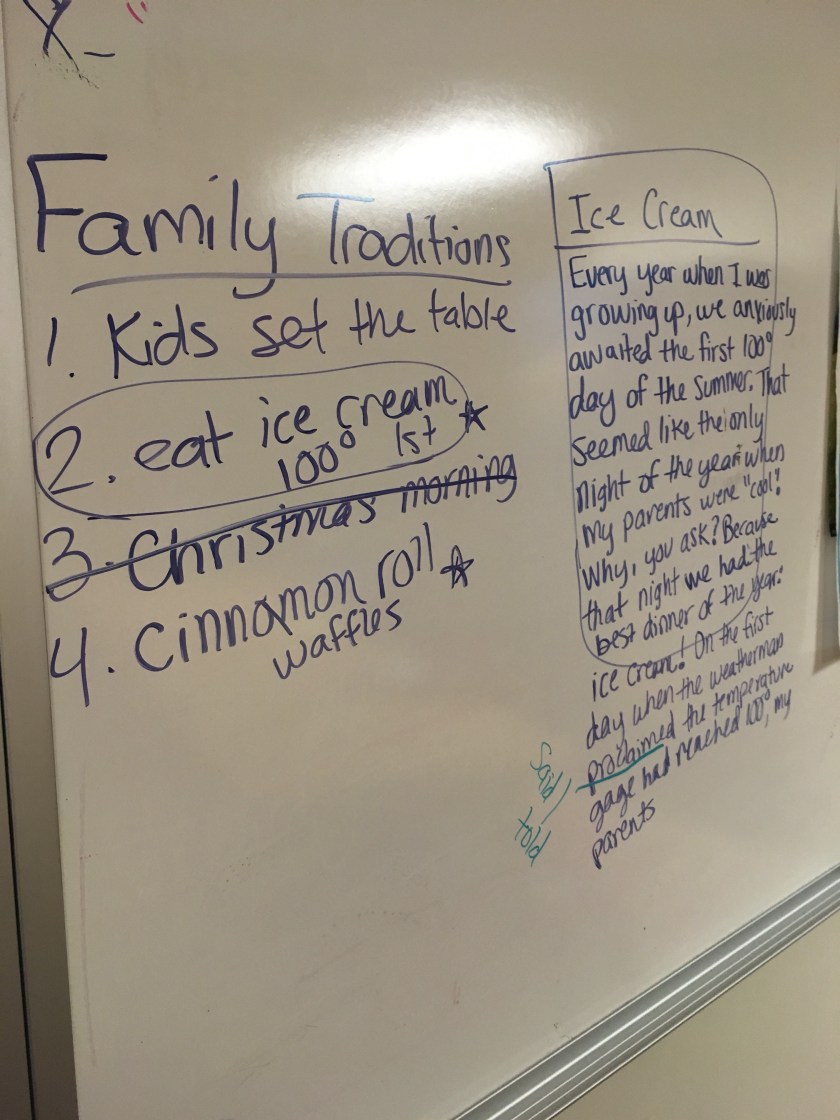
Last year, I attended some life changing writing trainings second semester. I get to start this year with all of that learning in mind. The best thing I learned is that I need to write when the students write. I’ve been doing that. We started our writing notebook with quick lists this week.

You can find awesome writing resources at bulbapp.com/shonarose2

-CL

Posted in Uncategorized

Teacher Rules

Teacher rules:

1.) you can turn ANYTHING into a game of Mexican Sweat.

2.) anything can be an excuse for students to get up and move

3.) anything can become an activity for fostering on topic small group talk.

4.) not everything has to be what it seems. Maybe instead of answering questions, kids are guessing questions based on their classmates answers.

5.) anything can be anything. Teachers decide if they are going to make it awesome or awful.

6.) extra work required: 2 min to cut out strips. Did it during passing period. #WorthIt

7.) the question on my head is a low level Q. But not all of them were. Low level Qs build confidence and provide cognitive breaks when kids have been working their brains hard. There is a reason I’m wearing this one and a student is wearing a question the length of a paragraph 👌🏼

-CL

Posted in Uncategorized

Wishlist…

Amy is a close friend of mine and a fellow educator. Who loves kids and families more than us? Please read her story and consider helping.

http://a.co/5kuVIVq

This Amazon wishlist is for my friend Any and her 5 foster kids!

On Thursday she was approved as a foster parent! 30 minutes later, she got her first emergency placement of FIVE (5) kids! Her heart is full… and now, so it her house and her car!!! Haha. She didn’t have any time to prepare for them, and since she was just approved, she had no supplies on hand. One reason this is so momentous for her is that Amy is a single foster parent and full time teacher with a car that only holds 4 kids! To say her hands are full is an understatement!

The kids are: twin boys age 5, Irish twins a boy and girl age 7, and another boy age 9!

They need some basics, and we can help lighten the burden for Amy while she coordinates school and appointments by purchasing from this list! All items will be shipped directly to her!

Underwear, socks, school uniform shirts, bedding, etc are priorities! There are also some basic toys listed as well! These kids care with the clothes they were wearing and backpacks… consider helping by purchasing from this list or sharing Amy’s amazing story! And, say a prayer for these babies and for Amy, and for the family from which they came. ❤️

Other ways to help:

PayPal: Amysoutherland@att.net

Facebook Fundraiser: https://www.facebook.com/donate/1448490565254919/

Share her story!

-CL

Posted in Uncategorized

Just a thought…

I’m in a few EDU related FB groups. Every day I see at least one post saying “my evaluation is this week. What is a good lesson I can do?”

I understand that no one wants an evaluation on a day when they are testing or something, but in general, if you are doing a one-day horse-and-pony show for your evaluation…. a.) your admin will know. B.) your kids will know c.) it will flop d.) if you think that is how you should teach for an evaluation, you should probably be teaching that way every day. 

I’ll put my soap box away now… 

Posted in English escapades, teaching, Uncategorized

a little bitty star.

I want to reflect a little bit on last school year. It was hard, and I doubted myself a lot. I was a first year English teacher. I tried hard to project confidence. I really did. I comforted myself in the silence of the night by rocking back and forth and repeating “I taught Spanish Literature for college credit… I taught Spanish Literature for college credit.”   I had to force myself to believe that if I can get students to read 38 works of literature in one school year and earn college credit when they really didn’t want to do all that work… I could do anything, even this.

I started last school year with a post about all the reasons I could, and would do this job. But, for all the confidence I posted last year, each day and each month proceeded to break me a little bit more. Could I really do this? Were my kids learning? Would they pass their exam? In May when we got our results, I was elated and disappointed. If I’m honest, I was mostly disappointed. Our pass rates aren’t nearly what I am used to and what I expected. However, despite that, we improved by 10% or more in every category. I was bum-fuzzled to say the least. How do the kids improve in every. single. area. and still only the same number of them pass? I knew my kids had significant gaps… but hadn’t I worked to fill them all year long? Perhaps a school year isn’t enough time to fill years of gaps…

This summer I wracked my brain. I made changes. I beat myself up.

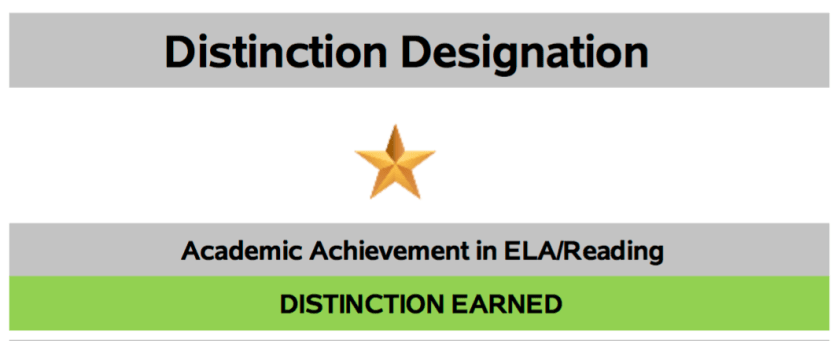
Then, in August, we got our State Accountability Ratings back. I was shocked to learn that our campus had earned a distinction in ELA / Reading. We only have 2 English teachers in our high school. Between the upper division teacher taking on and encouraging more dual credit students, and pushing them to earn credit, and the incredible reading / writing growth in my 9th and 10th graders… this is what I saw:

Screen Shot 2017-10-03 at 8.16.59 PM.png

I’d be lying if I told you I didn’t cry. I cried. I freaked out. I jumped up and down a little.

Our campus only earned this one distinction this year. Although we are consistently considered one of the better schools in our area, the standards for this distinction are very, very high. Additionally, our campus has never, in the history of distinctions (since 2002), earned the ELA/ Reading distinction. 

This little star restored my hope and my confidence that what I am doing/ and did do works. This little star is actually a really big deal. This is the culmination of every crappy day last year, every email dealing with another parent unsure of my methods, every fight with a student, every doubt, and every kid/ parent/ colleague who occasionally thought I had fallen off my rocker.

This little star holds every student who came to school and pushed their limits in grades 9-12, every teacher/ coach/ sponsor who pushed literacy and writing techniques and encouraged kids to focus on school, and every parent who made their kid show up and buck up. This little star is the STARt of something big.

My home is Spanish, but my home away from home isn’t so bad after all. 

-CL

Posted in professional development, Spanish relapses, teaching

So, what did you DO?

This is the question everyone asks me. They all want to know what I did. Did I help someone? Did I build a house? Install a well? Teach English? Teach in a school? Well, the short answer is that I didn’t do much–but in truth, I did quite a lot. I listened. I learned. I built relationships. I visited. I learned a whole lot more. And, the only actual product I made were some lessons, along with the other teachers there on the trip. Here is what I wrote upon coming home:

It was definitely NOT a mission trip! haha! I tried my best to share that as much as possible. It was an educational trip for teachers who have worked with The Pulsera Project in the past. We learned more about the organization, the other partnerships they have, the people they work with and employ, and the culture, economic systems, history, business climate, and language nuances. Then, we took that information and collaborated on lessons that will be used in nearly 2000 schools here in the United States that participate in the project. It was a whirlwind, entirely exhausting, and completely exhilarating.

In a conversation I had after returning home, another person observed that it was nice that we made lessons that would be used in Nicaragua. I corrected him by saying that The Pulsera Project believes we are the ones who have much to learn–and that the lessons would be used here in U.S. schools. He replied by asking, “And after your trip there, do you still believe that?” I gave him a resounding YES.

What more do we need to learn?

  • All of us need to continue to be educated on other cultures, languages, and economic systems/ realities.
  • All of us need to develop continued competency in Global Citizenship.
  • We need to develop an understanding of poverty and a better definition. Poverty is NOT the inability to get what we want. It is the inability to get what we need on a daily basis. Not one time. On. a. daily. basis. I guess we could start by defining “needs”.
  • We need to realize that we are not God’s gift to the developing world. We are not the solution to their problems. In fact, they have solutions. And in fact, often times, we are the problem.
  • Along those lines, we need to understand that just like someone cannot walk in and solve all the issues in our classrooms or in our marriages, we cannot walk in for a week or a month and solve all the issues in a person’s life, community, or country. These people are capable and willing, and they are often hindered by their economic or legal realities.
  • We need to be educated on responsible consumer practices. We should all know where our products are made, to the extent possible. We should be concerned that the people making our products are fairly compensated and work fair hours. We should be aware of the environmental impacts of our products and companies that produce them.
  • We need to contrast simplicity with poverty and critically examine consumerism and materialism.
  • Most of all, we need to be taught to think critically. Looking at another culture and the realities they face forces us to examine our own culture. In a global reality, we have to realize that while you and I do not directly create issues in other places, our actions are intimately tied to the system we participate in that does directly impact their realities.

One thing we shouldn’t be doing is focusing on how poor other people are so that we can revel in our own comparative richness. Humble gratitude is something we could all stand to continue developing, however focusing in on the lack of resources that other people have as a method of producing gratitude is sort of a sick twist on that (in my opinion).

I’d like to show you what I mean by this.

These two houses are right next to each other. The woman in the photo owns them both. In fact, the mud and bamboo construction was her original home, until she received a grant through the housing project at the Pulsera Project (available to the people employed by them as an employee benefit), which she used to build the brick home she is pictured with on the right. The grant has to be used for housing, but it is up to them what they do. They can improve their homes, buy land, add walls, add windows, or build a new structure. She chose to use the money to build this brick addition. I want you to notice something here. She did not tear down her mud and bamboo home. SHE ADDED TO IT. She did not tear it down. I’ll repeat myself again here: she did not tear it down.

Why not?

I’m guessing here, because although I asked her a ton of questions, it did not occur to me to ask this one at the time. But, one thought I have is that she isn’t ashamed of the house. I took the picture because I was amazed and impressed with it. I was in awe of it. She talked to our group about “re-taking” her heritage when she started weaving as a young woman, and re-taking is right! During a previous repressive government, indigenous traditions, including the style of weaving her group is renowned for, were not permitted. This home should not be the backdrop of some fifty-cents-a-day orphan commercial. This is a source of pride for her family. And I look at it now and I am amazed by the intricacies and skill it took to build.

I don’t feel sorry for her, nor do I feel sorry for a single person I met while I was there. I did not come back and hug my leather couches, though I thanked the Good Lord for air conditioning, because I’m a wimp. Rather than looking down on someone for what they don’t have, or giving others our pity, maybe what we should feel is righteous, justified anger that perfectly capable, well-educated humans don’t have access to the resources they need to implement the solutions they already have.

One of the Pulsera Project staff members related his experience owning a restaurant in Nicaragua and struggling between the “western standard of hospitality” and the Nicaraguan standard. He realized that the goal shouldn’t be to provide a western standard of hospitality, but to provide the appropriate cultural standard to their guests unapologetically. He said that when he stopped trying to fight the culture, his job got so much easier.

I believe we can all learn something from his story. We can’t fight their culture, and it isn’t our fight anyway. Our standards don’t apply, and they really shouldn’t. While we can all learn from each other, it should be just that: learning. What they do with it is up to them. And, in the end, we should be focused on helping capable people have access to the resources they need to create their own paths, not the paths we think they should follow.

So, 1200 words later: what did I do? I listened. I learned. I built relationships. I worked on some lessons designed to help students think critically about language, culture, and global citizenship.

-CL

Posted in professional development, Spanish relapses, teaching

Home, in more ways than one

I’m back from Nicaragua, and I promised to write about my trip, so here it goes. On Thursday when I got home, I posted this:

Home.
Goodness, this word has so many different meanings. I’m at home now. I’m with my family. But, I wasn’t not home before. In some ways the trip to Nicaragua was like returning home to where I really belong. Home isn’t always a space we occupy or the people we occupy it with. Sometimes it is what you do or the language you speak.
Tonight, I’m home. I’m back from a long trip away from where I desperately wanted to be, in profoundly more ways than one.

Of course, I’m home now. Being away from my boys for 8 days was difficult, especially with a busy schedule and limited access to internet. I missed them so much. I missed how my sons crawl into bed with us every night. I missed how my husband and I banter and discuss the details of our day. I missed how my pups only listen to me and no one else.

But, being away also brought me home in ways I can’t ignore. This last year has taken me on a long journey away from things that are essential to who I am. I never imagined an entire year where Spanish was not a part of my daily life. I never imagined feeling like an island. I never imagined I’d long so much for professional relationships and space to collaborate. I never imagined that after a year away from home, I’d get to go back by going away.

I went on this trip with amazing professional educators and Pulsera Project staff members who were dedicated to their values and ethics. An idea that came up over and over was the idea of “doing it right”. I felt like a starving bear at a buffet. I loved that my ideas were challenged and changed and valued. I loved learning and growing. I loved the validation that comes from dialogue. I loved being home for a little while.

-CL

19477676_10156470923273569_3419176611060072379_o
Here’s us at our best. Photo Credit: Chris Howell

I can’t wait to continue sharing more about this trip in the coming days! Stay tuned.

Posted in Uncategorized

Pulsera Project Teacher Trip Q & A

This is an update I posted to my GoFundMe for my Pulsera Project Trip. I thought some of you would like to read it, too 🙂

Hi all!
On Thursday evening I hosted a Facebook Live Q & A session, and I got some really great questions about my trip. I decided to host the session because several people have been asking great questions, and I thought this would be an easy way of sharing information about what I’ll be doing. I’ll summarize some of the questions here!
Q: Is your trip with the Pulsera Project a mission trip?
A: No, not really. This is an educational trip for teachers. It is with a non-profit organization that is not affiliated with a religion and focuses it’s efforts both here and in Nicaragua. The work in the U.S. is primarily through service-learning for students and Pulsera sales. I understand the confusion, because I am highly involved in my church. I will say that this organization models what I believe to be a more effective way of meeting needs (which is the true definition of mission work–not to be confused with evangelism). People used to (and sadly some still do) go places and give people stuff, but this is ineffective (watch Poverty Inc documentary for more info). The Pulersa Project is all about educating and empowering people to raise themselves from poverty through sustainable (and fair) work opportunities, micro loans, and education opportunities.

Q: If it isn’t a mission trip, what will you be doing there?
A: A whole lot of things! We are going to be getting an inside look at how the organization works, what they do with the money from pulsera sales, and who they work with. We will be meeting pulsera artists, as well as people from other organizations with similar missions. We are going to be observing the culture, the situations, and the solutions people there are working to formulate. As I mentioned before, a huge part of what the Pulsera project does is education in the U.S., so we (a group of 8 teachers selected from across the country) will also be giving input on new lesson ideas and contributing to that process. Of course there will be some tourism, too. For instance, one night, we will be going to see an active volcano!

Q: Can I fit in your suitcase?
A: No, but I really wish you could! I’m planning to take only carry-on luggage on this trip!

Q: Do you speak Spanish?
A: Yep! That is actually one of the requirements to be selected for the trip! The Pulsera Project has many cross-curricular opportunities, but they primarily work with Spanish Teachers and World-Language departments because the culturally authentic material they produce is primarily in Spanish, of course.

Q: How long is the trip?
A: 8 days!

Q: Is it a large group setting?
A: Nope, not at all. Actually, only 8 teachers in the U.S. were selected for the trip. It will be us, and a few people from the organization.

Q: Will you be sharing information from your trip?
A: YES, YES, AND YES! I plan to share information here and on my blog (cwilsonspanish.com). I hope to share cultural information, information related to teaching, as well as some personal experiences. I plan to keep this page up so that people who have supported this campaign financially and with their thoughts, well-wishes, and prayers can see the results of their generosity.

Q: Will this be your first time in Nicaragua?
A: Yes, it will. I have been to Costa Rica several times, which is just south of Nicaragua, so I am familiar with the climate, however this is my first trip to the country 🙂

Q: What are your goals in Nicaragua?
A: I have several. I would like to positively contribute to the lessons that the Pulsera Project provides. Not only have these lessons positively impacted my students, but my own teaching of them has permanently changed me as an individual as well. On a personal level, I love to learn, so I have a personal goal of learning more about the culture and continuing to improve my Spanish. Lastly, most teachers understand the burn-out you feel in May/ June. I’m looking forward to being re-invigorated by the knowledge that what we do works.

Thank you to everyone who asked questions! And again, thank you to everyone who has supported me in this trip! Stay turned for more updates -C. Wilson